


hCB1(2)
Nomenclature
C57BL/6JSmo-Cnr1tm2(hCNR1)Smoc
Cat. NO.
NM-HU-250165
Strain State
Repository Live
Gene Summary
Gene Symbol
Cnr1
Model Description
Validation Data

Fig.1 Detection of CNR1 expression in cerebellum by RT-PCR. Cerebellum RNA was extracted from wild-type C57BL/6 mice and homozygous hCB1(2) knockin mice, then cDNA libraries were synthesized by reverse transcription, followed by PCR with mouse or human mRNA primers (n=2, male, 7 weeks old). Mouse Cnr1 mRNA (373 bp) was detectable only in wild-type C57BL/6 mice. Human CNR1 mRNA (209 bp) was detectable only in homozygous hCB1(2) knockin mice but not in wild-type mice.
Abbr. M, marker; HO, homozygous; WT, wild type.
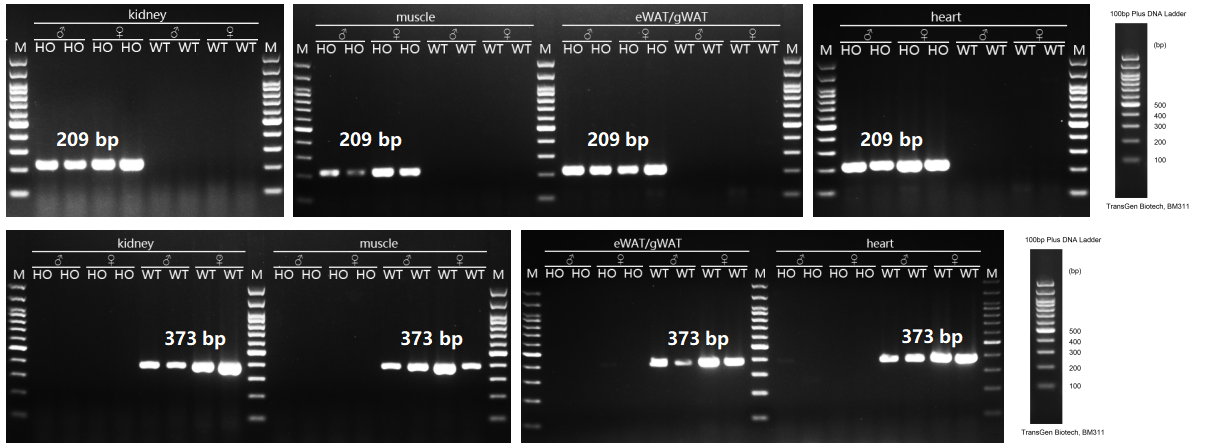
Fig.2 Detection of CNR1 expression in muscle, heart, kidney, epididymal White Adipose Tissue (eWAT of male) and gonadal White Adipose Tissue (gWAT of female) by RT-PCR. Mouse Cnr1 mRNA (373 bp) was detectable only in wild-type C57BL/6 mice. Human CNR1 mRNA (209 bp) was detectable only in homozygous hCB1(2) knockin mice but not in wild-type mice. Tissues RNA was extracted from 7-week-old male and female wild-type C57BL/6 (WT)(n=4) and homozygous hCB1(2) knockin mice (HO) (n=4), then cDNA libraries were synthesized by reverse transcription, followed by PCR with mRNA primers.
Abbr. M, marker; HO, homozygous; WT, wild type.

Fig.3 Detection of CB1 expression in hCB1(2) mice by WB. CB1 was detectable in eWAT/gWAT, iWAT, muscle, kidney and heart from both WT C57BL/6 and HO hCB1(2) mice , as the antibody was cross-reactived between human and mouse CB1. The eWAT/gWAT, iWAT, muscle, kidney and heart tissue lysates were collected from 6-7-week-old wild-type C57BL/6 mice and 7-week-old homozygous hCB1(2) mice, and then analyzed by western blot with anti-CB1 antibody.
Abbr. HO, homozygous; WT, wild type; M, marker; WAT, white adipocyte tissue; PC, mouse brain tissue lysates.
You may also like
Workshop:Progress and Advances in Preclinical immuno-Oncology Research
SMOC’s Annual Progress and Advances in Preclinical immuno-Oncology Research: The workshop is designed as a forum for ideas and opinions exchange on how to decrease the rate of clinical failures in oncology and immuno-oncology.
Learn moreShanghai Model Organisms Center Inc has licensed CRISPR-Cas9 technology from Broad Institute
On Dec 16, 2018, Broad Institute and Shanghai Model Organisms Center Inc (SMOC) has entered into a non-exclusive license agreement under which Broad has granted SMOC worldwide rights to commercialize a service platform for genetically modified mouse models under Broad's intellectual property.
Learn moreCustomizing Mouse Models: Delivering in 100 Days to Speed Up Your Research!
At GenoBioTX, we understand that the lengthy wait times for gene-modified mouse models can hinder your research progress. Traditional methods often require 6-9 months, leading to delays and increased costs. That’s why we’re thrilled to introduce our innovative service designed to streamline this process and deliver results faster.
Learn more
